The Quiet Power of Qi Gong: Finding Harmony in Movement
There’s something undeniably captivating about the quiet strength of a tree or the slow, steady flow of a river. These aren’t forces that push or strain; instead, they work within the natural order, moving with ease and purpose. That’s the essence of Qi Gong, a practice that offers a way to connect with this same effortless power within ourselves, tapping into a sense of balance that feels as natural as breathing.
At its core, Qi Gong is a practice of movement, breath, and intention. It’s deeply rooted in ancient Chinese wisdom, where the term “Qi” refers to life force or energy, and “Gong” means cultivation or skill. Together, Qi Gong is the cultivation of life energy, a practice that helps us nurture the flow of Qi within, allowing it to circulate through our body, mind, and spirit in a way that brings harmony and health.
Why Practice Qi Gong?
Life these days can feel like it’s all rush and tumble, with stress creeping in from every direction. Many of us spend our days juggling responsibilities, navigating screens, and trying to keep up with the demands of work, family, and social life. It’s easy to get caught up in a constant state of doing, leaving little time for simply being. That’s where Qi Gong comes in, offering a way to step out of the rush, reconnect with ourselves, and restore that sense of inner peace we often overlook.
People turn to Qi Gong for a host of reasons, and its benefits are as varied as the folks who practice it. For some, it’s a way to ease physical discomfort—relieving tension, reducing pain, and improving flexibility. Others find it’s a great tool for managing stress, with the slow, mindful movements and deep breathing promoting a calming effect that carries through the day. And then there are those who are simply looking for a practice that brings a bit of balance, helping them feel more grounded, centered, and connected to the world around them.
"When moving, be like water, Still, be like a Mirror." Zhuangzi, 3rd century BCE
The Practice: Simple, Mindful Movements
One of the beautiful things about Qi Gong is its simplicity. Unlike some forms of exercise that require specialized equipment, a gym membership, or even a specific location, Qi Gong can be practiced just about anywhere with a bit of space. All you need is a quiet spot where you can move freely, and a few minutes of your time. It’s a bit like rolling out a mat and stretching, but with an emphasis on intentionality and flow.
Qi Gong is made up of a series of gentle, flowing movements designed to encourage the natural flow of Qi. Each movement is performed slowly, with a focus on breath and awareness. This isn’t about pushing yourself to the limit or trying to break a sweat. Instead, it’s about finding a rhythm that feels right, listening to your body, and moving with ease.
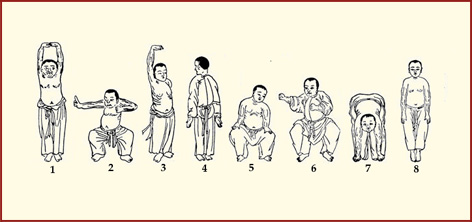
The beauty of these movements lies in their adaptability. Whether you’re just starting out or have been practicing for years, you can modify each movement to suit your own level of flexibility and comfort. You might begin with a simple exercise like Gathering Qi, where you stand with your feet shoulder-width apart, raise your arms up toward the sky, and then gently draw them down to your sides. Or try Cloud Hands, a slow, sweeping movement that mimics the way clouds drift across the sky. These are movements that can be as small or as large as you like, allowing you to gradually increase your range of motion and explore the flow of energy within you.

Strengthening Tendons for Lifelong Mobility in Qi Gong
In Qi Gong, there’s a special focus on strengthening the tendons, the fibrous tissues that connect our muscles to our bones, because they play a vital role in promoting mobility, stability, and longevity. Through gentle, intentional movements, Qi Gong helps to stretch and condition the tendons, making them more resilient and flexible over time. Unlike exercises that target only muscle strength, Qi Gong’s tendon-strengthening movements work on a deeper level, promoting a body that feels both relaxed and agile. This approach is rooted in the belief that strong tendons support the body’s natural alignment and encourage a graceful, fluid way of moving that we can carry with us throughout our lives. By cultivating tendon health, Qi Gong offers a path to increased vitality, a lighter step, and the enduring freedom that comes with a balanced body.
Breath: The Bridge Between Body and Mind
In Qi Gong, breath is just as important as movement. Each inhale and exhale is an opportunity to tune in to the present moment, letting go of distractions and centering yourself. By focusing on the breath, we cultivate a sense of mindfulness, a quiet attention that helps us stay grounded even when life gets a little chaotic.
Breathing in Qi Gong is typically slow and deep, allowing the breath to move naturally through the belly rather than the chest. This is sometimes called abdominal breathing or belly breathing, and it’s a technique that encourages relaxation and activates the body’s parasympathetic nervous system, which is responsible for our rest-and-digest response. In other words, deep breathing helps to counteract the effects of stress, allowing the body to relax and recharge.
One of the easiest ways to incorporate breath into your Qi Gong practice is to begin with a few deep breaths before you start moving. As you inhale, imagine drawing in fresh energy, filling your body with a sense of calm and strength. On the exhale, visualize letting go of any tension, releasing it back into the earth. By pairing breath with movement, we create a rhythm that brings a sense of harmony to the body, mind, and spirit.
Mindfulness: A Key Element of Qi Gong
Qi Gong is more than just a physical practice; it’s also a form of moving meditation. Each movement is an opportunity to cultivate awareness, to notice how your body feels, and to observe the thoughts and emotions that arise. This mindfulness is what sets Qi Gong apart from other forms of exercise, transforming it into a practice that nourishes not only the body but also the mind.
In a world that’s always pushing us to think ahead or dwell on the past, Qi Gong invites us to be fully present, to experience each movement as it unfolds. There’s no rush, no need to achieve a certain level of skill, or to compare yourself to others. Instead, it’s about letting go of expectations and embracing the process, allowing yourself to move and breathe with a sense of curiosity and openness.
Getting Started with Qi Gong
Starting a Qi Gong practice doesn’t have to be complicated. You don’t need any prior experience, and you certainly don’t need to know all the moves. The best way to begin is simply to set aside a few minutes each day to explore the practice, letting it unfold naturally.
If you’re not sure where to start, there are plenty of resources available, from online videos to local classes. You might even find a Qi Gong group in your area where you can practice with others, share tips, and enjoy the sense of community that comes with practicing together. However you choose to start, remember that Qi Gong is a personal journey, one that unfolds at your own pace.
The Journey: Cultivating a Lifelong Practice
As you continue to practice, you’ll likely find that Qi Gong becomes a source of strength and resilience, something you can return to whenever you need a moment of calm or a bit of grounding. Over time, you might notice changes in the way you feel, both physically and mentally. You might feel a bit more flexible, a bit more relaxed, and a bit more connected to the world around you. And isn’t that something worth exploring?
Qi Gong is, at its heart, about finding harmony within ourselves and with the world around us. It’s a practice that invites us to slow down, to listen, and to move with intention. So why not give it a try? Step outside, take a deep breath, and let yourself be guided by the quiet power of Qi Gong. You might just find that this ancient practice has something new to offer you, right here and now.
Related Articles
Daoism: The Way
“That which offers no resistance, overcomes the hardest substance.” – Laozi
Finding Flow
Imagine being so deeply immersed in an activity that everything else falls away.
Good Books